Introduction
As a young boy, I was intrigued by ancient civilizations and lost cities like the ghost towns of the wild west and vast empires of earlier days. Images of historic battles, historic events and busy city streets filled my head as I speculated what it would be like to live during those time periods. How interesting it would be to be able to witness the signing of the Magna Carta, to visit the hanging gardens of Babylon, to speak with the settlers at Jamestown, or to worship the baby Jesus in Bethlehem. Now I am no longer a young boy. I am not even a young man. But I never lost my curiosity about those civilizations, cities, and historic events. Once prosperous and bustling with life, they are now shadows of their former glory or they lie as dusty ruins, sometimes buried in the sands of time.
The City of Colossae
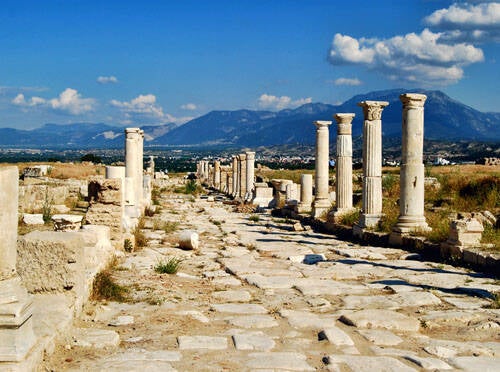
The city of Colossae was one such city. Nestled in the Lycus Valley of south-central Asia Minor (modern Türkiye), it was situated along the trading route about one hundred miles east of Ephesus. Known for its wool and dye industry, it had grown to be a small market town by the time of Paul’s writing his letter to the Church of that city.[i] Unfortunately, the city was built in an area prone to earthquakes. The thriving market town was eventually destroyed by an earthquake in A.D. 60 and was probably never rebuilt. There is no mention of the city in any Christian or pagan writings after A.D. 61.[ii] Now Colossae is only dusty ruins and a distant memory for those who are now long gone.
Paul’s Parent Night
When reading Paul’s letter, memories of earlier days come to mind. When my sons were younger and in school, I remember going to their school during parent night. It is a night when parents are invited to the school to meet the teachers and talk about the progress of their children during the school year. Parents and teachers can also address any problems they are having or any anticipated problems. Hearing the good reports of my sons’ grades and their good behavior always filled me with pride and joy. It was pleasing to know that my children were doing well in school and that they are boys of good character. This is a simple example of how Paul felt about the Church in Colossae. Of course, Paul was not their parent. The Church in Colossae was not an elementary school. But, in a sense, Paul accomplished the same goals as a parent/teacher conference on parent night. As an Apostle to the Gentiles, He was pleased with their growth and progress. He praised them for the good reports that he heard of their Christian love for one another. As an Apostle, he also was concerned that his beloved Christian brothers in Colossae could be influenced or led astray by a heretical teaching that was quickly spreading. He wants them to be prepared for any possible upcoming spiritual battles.
The Colossian Church
The Church at Colossae, founded by a man named Epaphras, was a mixture of Jewish and Gentile Christians, given the large Jewish population that resided in the city.[iii] Although Paul is not the founder of the Church at Colossae, as an apostle, he did have authority over the Church.[iv] Paul’s relationship with the Colossian church went beyond that of an authority figure. He had great affection for the Colossian Christians. He referred to them as “holy” (set apart by and for God), “faithful” (they were committed to the gospel), and as “brothers” (they were no longer Jews or Greeks, but one spiritual family). The Colossian Christians had a genuine love for one another. This genuine Christian love resulted in a strong Christian community, including both Jews and Gentiles.
The Threat to the Colossian Church
It is uncertain exactly what the heresy was. What can be known for certain are the elements of its teaching. The heresy denied the central place of Jesus in the gospel message. It included angel worship and mystical asceticism.[v] It was a legalistic heresy that denied the Trinitarian authority of the Godhead. Some scholars believe that the heresy had an Essene origin given the involvement in asceticism. Others believe that it stemmed from the teachings of Gnosticism due to the practice of angel worship. Regardless of its origin, this heresy would be very damaging to the Church, if it were allowed to creep into the hearts and minds of the Colossian Christians.
Conclusion
False teachings have always threatened the Church. Today’s world is no different. Although the names of the false teachings may be different. The dangers are still very real. Today the Church faces dangers from false teachings such as the prosperity gospel, Mormonism (Latter Day Saints), and Jehovah’s Witnesses (Watchtower). The Church also faces threats from false religions including Islam, Buddhism, Hinduism, and Scientology. And, more recently, the drift of some mainstream denominations to accept the practice of same-gender relationships and the ordination of clergy who openly live a homosexual lifestyle. This list is not exhaustive, but it represents the necessity of being grounded in the Truth of the Gospel of Jesus Christ. Paul’s lesson to the Colossian Church regarding the centrality and sufficiency of Christ in the gospel is relevant for today. If the apostle Paul were to have a “Parent Night” at the church you attend, would he be pleased? What warnings might he give the Church today?
____________________
[i] Richard R. Melick, Jr., Philippians, Colossians, Philemon, Vol. 32, New American Commentary. (Nashville, TN: Broadman, 1991), 163.
[ii] David E. Garland, Colossians/Philemon, NIV Application Commentary. (Grand Rapids, MI: Zondervan, 1998), 17.
[iii] Max Anders, Galatians, Ephesians, Philippians, & Colossians, Vol. 8, Holman New Testament Commentary. (Nashville, TN: Broadman & Holman, 1999), 274.
[iv] Ibid.
[v] Ibid., 175.
Add comment
Comments